The art of becoming: A manifesto for “Your Reality is a Construction” philosophical movement

Reality is a canvas, not a cage; its form bends to the will of imagination. To live is to shape, to question, and to become. What follows is a call to awaken, to create, and to master the art of existence—a manifesto for the “Your Reality is a Construction” philosophical movement.

  1. We strive to wake up from convention of thought and feeling.
  2. We question our realities to break from the spell of their constructed nature and choose to live the lives that we imagine.
  3. As everything changes, there is no ‘being’ but ‘becoming’. We understand change, so we keep building in the rivers of impermanence; always conquering new horizons.
  4. We understand that chaos gives birth to dancing stars.
  5. We work toward increasing the space between stimulus and reaction, to be in command of ourselves.
  6. By interiorizing the premise “our reality is a construction”, we assume that we have a profound responsibility to ourselves and others.
  7. We are value creators.
  8. We apply energy to the systems we are part of, following a set of principles that align with our intended reality and ethics.
  9. We understand that our realities are ours to create and craft them in the present moment.
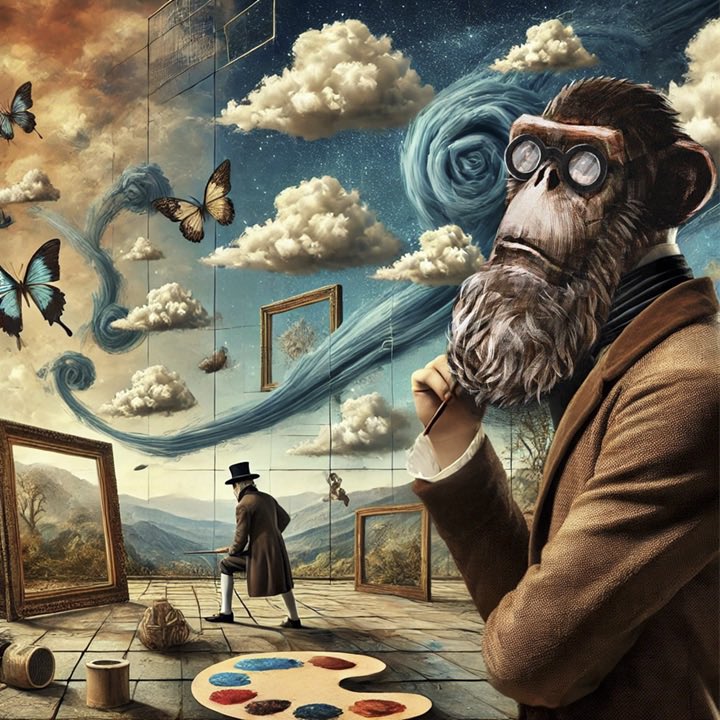
  10. Our lives are our canvasses, imagination our painting, and experimentation our technique. We understand that the contents of our lives are our art to craft.

Thorpe Brown’s critical thinking manifesto for our times

Clarity is not born of certainty but of courage—the courage to question, to doubt, to listen, and to grow. In the complexity of modern life, let these principles guide your steps as a lantern through the fog of complexity.

1. Cultivate intellectual humility and admit your limits. Recognise that no one has all the answers, including yourself. Acknowledge the boundaries of your knowledge. Being open to learning is more valuable than insisting on being “right”.

2. Reflect on your biases. Reflect on your own thought processes and how your experiences and preferences influence your thinking. Be aware of cognitive biases and strive to minimise their impact.

3. Question assumption. Challenge accepted truths and your own beliefs. Consistently ask, “Why do I believe this?” and “What evidence supports it?”

4. Seek diverse perspectives. Explore different viewpoints to broaden your understanding. Engaging with a variety of perspectives reduces bias and promotes innovation.

5. Distinguish facts from opinions and analyse arguments critically. Separate evidence-based facts from personal beliefs or societal narratives. Recognise that personal experience is not necessarily the best evidence for facts. Evaluate reasoning for consistency and logic. Identify logical fallacies and avoid being swayed by emotional appeals or rhetoric.

6. Employ systematic problem-solving. Approach problems methodically. Define the issue, gather information, generate options, and weigh potential outcomes.

7. Triangulate evidence and consider context. Verify information by consulting multiple reliable sources. Understand the broader circumstances surrounding information and ideas. Recognise that context affects interpretations and conclusions.

8. Embrace uncertainty. Accept that not all questions have clear answers. Be comfortable with ambiguity, as it can lead to deeper understanding and new insights.

9. Engage in open dialogue. Discuss ideas respectfully, even when they challenge your own. Open communication fosters mutual understanding and growth.

10. Test ideas through action. Apply theories in real-world situations. Practical experience can validate assumptions or highlight areas for improvement.

11. Consider implications and consequences, and act with intellectual integrity. Think about the potential outcomes of ideas and actions. Reflect on ethical considerations and the impact on others. Be honest in your pursuit of knowledge, admit mistakes, and stay true to your principles.

12. Advocate for free enquiry. Support the freedom to question and explore. Encourage environments where curiosity and critical thought can thrive.

13. Cultivate empathy. Understand others’ perspectives and feelings to build stronger relationships and foster collaborative solutions.

14. Develop media literacy. Critically evaluate the reliability and purpose of information sources, especially in digital media.

15. Practise patience and perseverance. Recognise that critical thinking is a skill that develops over time with consistent effort.

16. Commit to lifelong learning. Embrace ongoing education and personal development to adapt to new information and changing circumstances.

By adopting these principles, we nurture curiosity, resilience, and clarity—essential tools for navigating today’s challenges and contributing to a more thoughtful, open society.

The masks we wear

We wear masks not to conceal but to unveil a deeper truth: Our identities may be but layers of pretence, each mask a threshold, not a wall.

Sometimes, we dread the face beneath—yet what if that face is itself a mask, crafted from habit, fear, and the chains of society’s expectations?

In the silent gaze of the darkened mirror, the question persists: Who are we when the masks slip, and who are we when we choose them? 🎭

Thus spoke Thorpe Brown

Who am I?

Who am I? Am I just a name, a thinker, a collection of ideas?

I am the ever-evolving spirit—a relentless questioner who refuses the comfort of simple answers.

I cannot be confined to one identity, for I am the ceaseless becoming that destroys to create anew.

Welcoming both joy and suffering, I journey through cycles of creation and destruction, flowing in life’s eternal contradictions and complexities, always reaching for the best version of myself.

Thus spoke Thorpe Brown

Wake up!

You are waking up to the constructed nature of your reality. Your reality is a construction. This reflection can make our worlds crumble and lose meaning. Waking up from the illusion is not always easy. What is reality? What is all this we call ‘the experience of life’ about? The world around us, our perceptions of it, our likes and wants, or communities and societies, are all constructions, aren’t they? What are we putting ourselves through and what are we living for?

These questions are also incredibly liberating, though, and can transform our minds; our realities are ours to create.

Where there is chaos, there’s also opportunity. As Friedrich Nietzsche said, “One must still have chaos in oneself to be able to give birth to a dancing star.” If our realities are constructions, that means that we can de- and re-construct them.

We have a say in what gives meaning and value to our experience of life. And when we have meaning, when we have a why, Nietzsche’s wisdom has also something to say here, “…who has a why to live for can bear almost any how.” When you own and construct your reality, you move forward toward the meaningful life.

Now, we can see our lives as our canvasses, imagination as our painting, and experimentation as our technique.

I want to move toward fulfilling my mission: To facilitate reality questioning so that we dare to live the lives that we imagine, by waking up and breaking the spell of our constructed realities.